AmneziaWG Obfuscation
AmneziaWG is a WireGuard-based VPN protocol featuring built-in traffic obfuscation. Its obfuscation parameters control how traffic is disguised to evade detection under restrictive network inspection.
Below is a detailed introduction of AmneziaWG, version differences, AmneziaWG on GL.iNet routers, and parameters overview.
Why AmneziaWG?
The predecessor of AmneziaWG, WireGuard, has established itself as a fast and reliable VPN protocol thanks to its compact codebase and high efficiency. However, its fixed packet headers and predictable packet sizes create an easily recognizable signature. DPI systems can effortlessly identify these packets and immediately terminate connections — a critical issue in countries with strict internet censorship.
AmneziaWG inherits the architectural simplicity and high performance of the original WireGuard implementation, while adding a dedicated obfuscation module to hide VPN traffic patterns. This helps consumer and business users safeguard online privacy and maintain stable connections under restrictive network environments.
In short:
-
It masks VPN characteristics to prevent detection by ISPs, firewalls, or Deep Packet Inspection (DPI).
-
It makes your VPN connection appear as standard web traffic, improving connection stability and success rate in restricted networks.
AmneziaWG V2.0
Compared with AmneziaWG v1.0, v2.0 provides stronger obfuscation by adding new parameters (S3~S4) and using dynamic headers for packet types (H1~H4 as ranges instead of fixed values). In addition, AmneziaWG 2.0 supports the I1~I5 parameters, which send formatted UDP packets before each handshake to disguise AmneziaWG traffic as ordinary non‑VPN traffic, effectively bypassing deep packet inspection and enhancing connectivity in restricted networks.
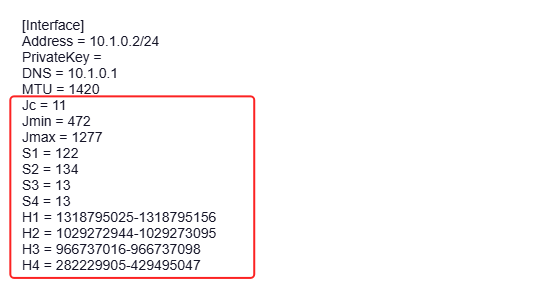
These enhancements make VPN traffic more difficult to detect while preserving WireGuard's high speed and low latency.
How to identify the AmneziaWG version?
V1.0: No S3-S4 parameters; H1-H4 are fixed single integers.
V2.0: It is V2.0 if any of the conditions below is met:
- Includes S3-S4 parameters
- H1-H4 are set as numeric ranges
- Includes customized I1-I5 parameters.
Note: I1-I5 are not auto-generated. Users can manually add them as extra lines in the configuration file to make AmneziaWG traffic look like other common protocols, such as QUIC or WebRTC.
Supported Model
AmneziaWG 2.0 is available on GL.iNet routers with firmware v4.9 or later.
To set up VPN obfuscation on GL.iNet routers, refer to this tutorial.
Parameter Overview
| Parameter | Description | Constraints | Auto-generated |
|---|---|---|---|
| Jc | The number of junk packets before the client initiating the handshake (for interference with traffic feature detection) | 1~128 | 4~12 |
| Jmin | Minimum size for random junk packets (bytes); Must be configured with Jmax to define junk packets size | 0 ≤ Jmin < Jmax < 1280 | 0 <= jmin < jmax < 1280 |
| Jmax | Maximum size for random junk packets | 0 ≤ Jmin < Jmax < 1280 | 0≤ Jmin < Jmax < 1280 |
| S1 | Random prefixes for Init packets | 0 ≤ S1 ≤ 1132 | 15~150 |
| S2 | Random prefixes for Response packets | 0 ≤ S2 ≤ 1188 S1 + 56 ≠ S2 |
15~150 |
| S3 | Random prefixes for Cookie packets | 0 ≤ S3 ≤ 1216 | 15~150 |
| S4 | Random prefixes for Data packets | 0 ≤ S4 ≤ 32 | 0~32 |
| H1~H4 | Dynamic headers for packet types; Random values (v1.0) or ranges (v2.0) | 5~2147483647; H1, H2, H3, and H4 must be different | 5~2147483647 |
| I1~I5 | Signature packets for protocol imitation | arbitrary hex-blob | N/A |
References: AmneziaWG Official Documentation
Related Article:
Still have questions? Visit our Community Forum or Contact us.